Configure the motor controllers
Give a metering motor controller its address, choose the kind of controller, and set its parameters.
The controllers that drive the metering motors are not addressed from “Sensors Configuration”. They have their own way in, their own choice of controller kind and their own parameters.
Open the motor controller menu
Raise the level to “Agronomist” (Enable the Agronomist level).
Tap the home screen with two fingers, tap “Service” twice, then “Electric motors” twice. The diagnostic screen of the controllers opens on motor 1. The same screen opens from “Electric motors” in the context menu of a motor.
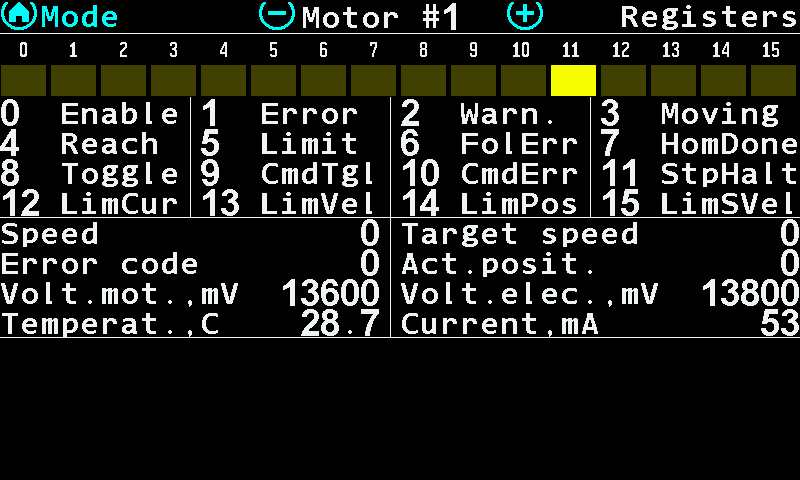
The Electric motors screen of motor 1, page “Registers”. Tap the screen with two fingers. Two items appear: “Change address” and “Configuration”.
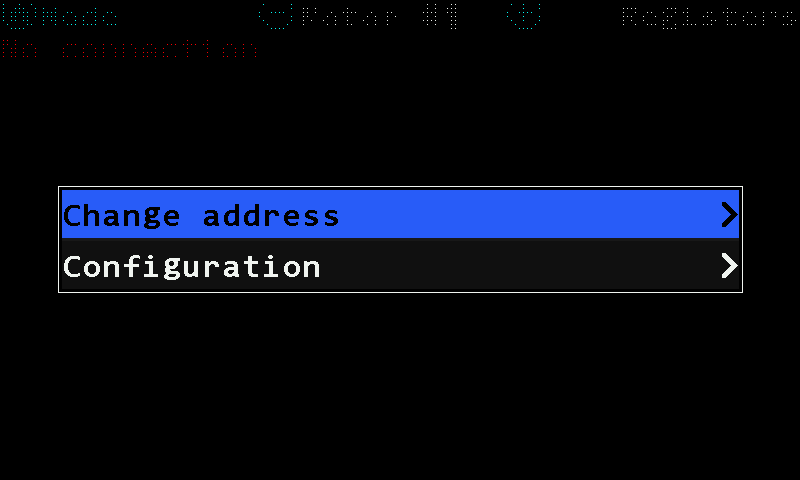
The menu of the Electric motors screen.
Change the address
Tap “Change address”, and tap it again. Three items open.
“Motor address” — the address the controller answers on now. Leave it as found.
“New address” — the address it is to take. Take it from the data sheet of the system; the values are not printed in this manual.
Tap “Set”, and tap it again, to write it.
Choose the controller kind
“Configuration” opens the choice of controller kind, offered by number. The panel reads the kind back from the controller and opens on the one that answers. Choosing another kind by hand is how a replacement board is set up — not a way to change what a motor is.
| Kind | What it is |
|---|---|
| “1)universal” | The universal controller: two DC channels or one stepper channel on the same board. |
| “2)DC motor” | A DC motor controller. |
| “3)STEPPER fw0.006+” | A stepper controller, firmware 0.006 and later. |
| “4)BGxxCI” | A BG45CI motor with the controller built in, on the older board. |
If the controller that answers does not suit the menu, the panel says so: “Wrong controller type!”, “Old firmware version!” or “Wrong controller work mode!”.
Set the parameters
Every configuration menu ends with “Set”, and “Set” carries a value of its own — the address group: “Motor address” (this controller only), “ALL”, “All-Seeding” or “All-Fertilizer”. Nothing reaches the controller until “Set” is entered — the items above it change the numbers the panel holds, not those the controller runs on. “Set” answers “Done”, “FAILURE” or “No connection”; a group that has no motors in the profile is answered with “EM of dispensers is missing in profile”.
| Kind | What it is given |
|---|---|
| STEPPER | “Pulses” 1 … 8192 — the pulses of one turn of the motor shaft; “Motor type” from a list; “Set”. |
| BGxxCI | “Pulses” 1 … 8192; “Set”. Nothing else — the controller carries the rest. |
| DC motor | “Pulses”, “Motor type”, the regulator terms “PID kP”, “PID kI”, “PID kD” (0 … 65535, read as hundredths), “TURBINA” 0/1, and two speed–time pairs “TIME1” / “SPEED1”, “TIME2” / “SPEED2”; “Set”. |
| universal | The largest set, in three menus: “Work mode”, “Inputs setup” and “Parameters”. |
The “Parameters” menu of the universal controller:
| Parameter | Range |
|---|---|
| “Motor type” | 0 … 255, from the controller's own table |
| “Pulses” | 1 … 8192 per shaft turn |
| “Acceleration,Ms” / “Deceleration,Ms” | 50 … 65535 — the ramp up and down |
| “Minimum, rpm” / “Maximum, rpm” | 0 … 65535 — the shaft speed window |
| “PID kP”, “PID kI”, “PID kD” | 0 … 65535, hundredths |
| “!! Temp,*C” | 0 … 200 — the temperature at which the controller alarms |
| “I_peak,A” / “I_peak,mS” | the peak current, in tenths of an ampere, and how long it may be drawn |
| “I_push,A” / “I_push,Sec” | the breakaway current and its time |
| “I_hilo,A” / “I_hilo,Sec” | the sustained-current threshold and its time |
| “Set” | writes all of it, at the chosen address group |
The four kind names and the items “PID kP”, “PID kI”, “PID kD”, “TURBINA”, “TIME1”, “SPEED1”, “TIME2”, “SPEED2”, “!! Temp,*C”, “I_peak,A”, “I_push,A”, “I_hilo,A” and their time partners read the same in every language of the panel.
Reading what the controller reports: Motor controller diagnostics.
Something your machine does that this page does not answer? Write to support@agriwelt.com — an engineer answers.