How alarms work
When the Hectare 5 raises an alarm, what the alarm window shows, how it is closed by touch, which faults sound without a window, and how to use the alarm topics of this manual.
An alarm is a window that opens over the working screen, with the alarm sound. It tells you that one device — a sensor, an actuator, a motor controller — or the system as a whole has found a fault. The alarm topics in this section are grouped by the device that raises the alarm. Look for the words you see on the screen, not for a description of them.
When the panel raises an alarm
A fault is not reported the moment it appears. The condition must hold without a break for the time set in “Alarm delay” before the alarm window opens.
| Setting | Value |
|---|---|
| Where it is set | “Settings” menu, item “Alarm delay”, at the “Operator” level. See The Settings menu. |
| Range | 2 to 20 seconds, in steps of 1 second. |
| Default | 3 seconds. A value outside the range is reset to the default by itself. |
A short delay makes the panel react quickly, but also to brief disturbances — a single bump, a momentary gap in the seed flow. A long delay keeps the screen quiet, but a real fault can run for up to twenty seconds before you are told.
Two cases do not follow the delay:
- Lost communication is counted in polls, not in seconds. “Connection lost” appears after three polls in a row without an answer from the device.
- Right after a sensor has been set up, its alarms are not processed for a short blocking period. This prevents a burst of alarms while a device is being configured.
The alarm window
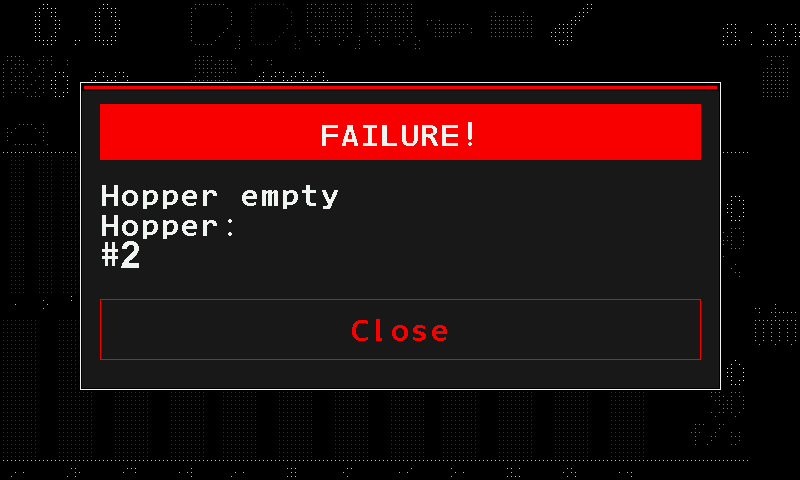
- “FAILURE!” — the title of every alarm window, on a red bar, whatever the fault. It is not the fault itself.
- The alarm text — the fault. Look it up under this text in the alarm topics.
- The kind of device that raises the alarm — here a hopper sensor. The same text can come from different devices; this line tells you which.
- The number of the device — here hopper 2. When several devices of the same kind raise the same alarm, they share one window and are listed together, for example #3-5,8.
- “Close” — closes this alarm. Below.
An over-current alarm of a motor adds a line with the current the controller measured, in amperes. The alarms of the panel itself — for example “User is Agronomist!” — have no device line; their text starts with the line “HOME - close message”. They are closed like every other alarm, with “Close”.
Closing an alarm
Tap “Close” in the window. This alarm closes and the sound stops. If more alarms are waiting, the next one opens. Nothing else closes an alarm window — taps elsewhere, swipes and the three-finger tap are ignored while it is open.
Closing a window does not repair the fault. The alarms of a device that are still active are counted on its status screen — see The sensor status screen.
Alarms are hidden at the higher access levels
At the “Agronomist” and “Service” levels no alarm windows are shown — apart from the one warning that says so, User is Agronomist — and the faults without a window stay silent too. The alarms are not lost: they wait. When you return to “Operator”, the panel drops the ones that have gone away and shows the ones that are still true, one after another. See Access levels.
Alarms without a window
Two faults are not shown as a window, because you have to see the working screen while you correct them. At the “Operator” level the alarm sound plays while they last, as long as no alarm window is open:
- “SLOWER” or “FASTER” — the travel speed is outside the limits set for the speed sensor. The speed field shows the word. See Indicators.
- “NOT UNDER CONTROL” — rows run under the control line of their diagram. See The section diagram.
How the alarm topics are written
Every alarm has its own heading with the text exactly as on the screen; where the message has two lines on the panel, both lines are given. Under it: what the panel has detected, and what to check, in the order a mechanic checks it — the quick checks on the panel first, then the machine, then the device itself.
Something your machine does that this page does not answer? Write to support@agriwelt.com — an engineer answers.